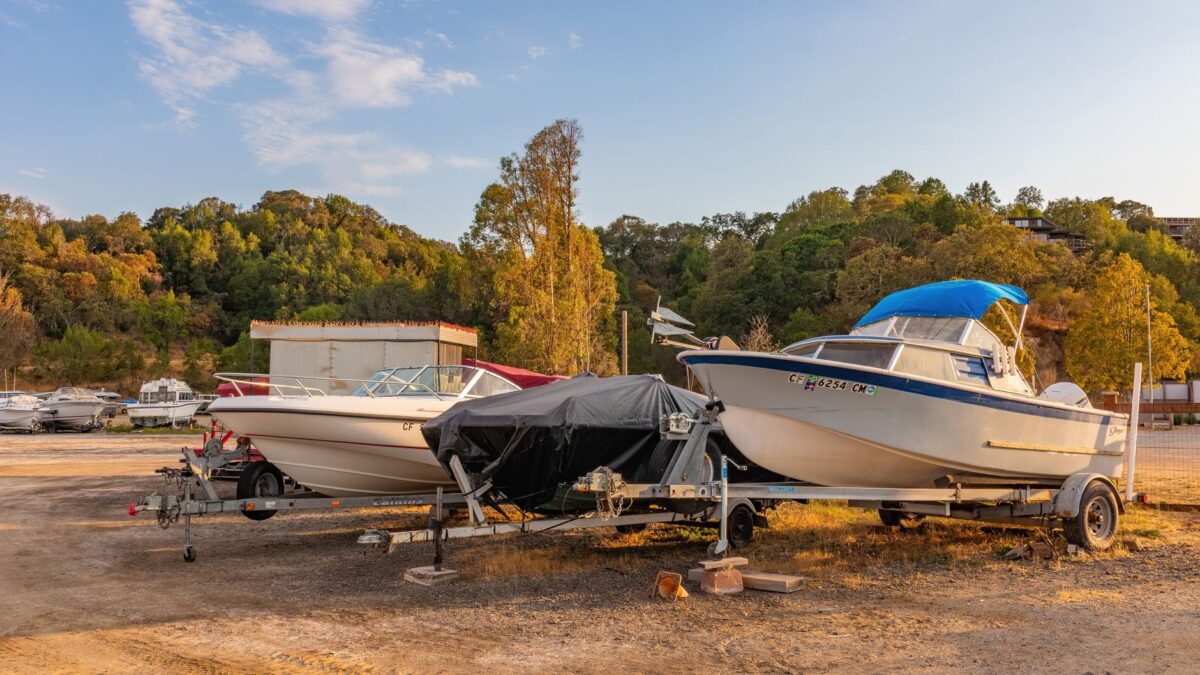
Boat trailer insurance is the part of a marine policy that pays for damage to, theft of, and liability from the trailer your boat rides on. Most boat owners assume the trailer is automatically covered. In most cases it is not. Your auto liability follows the trailer down the highway, but it will not pay a dime to repair or replace the trailer itself. Your homeowners policy usually excludes it too, because a registered trailer counts as a licensed vehicle. That leaves a real gap. A tandem-axle aluminum trailer under a 24-foot center console can cost $6,000 to $9,000 to replace in 2026. Boat trailer insurance closes that gap for a few dollars a month, which is why almost every marine carrier now offers it as a named add-on.
What Boat Trailer Insurance Actually Covers
Boat trailer insurance is written as a scheduled item on your boat policy, with its own stated value and usually its own deductible. Coverage applies whether or not the boat is sitting on it. Progressive, for example, pays for trailer damage even when the trailer is parked empty in your driveway. Covered perils typically mirror your hull coverage: collision, fire, theft, vandalism, windstorm, hail, and flood. A blown bearing that sends the trailer into a guardrail is a covered collision loss. So is a hurricane that flips it in the side yard.
Theft is the claim boat owners file most. Unattended trailers get stolen from launch ramps, storage lots, and motel parking lots. Comprehensive on the trailer pays the actual cash value at the time of loss. However, that value is depreciated. A ten-year-old galvanized trailer that cost $4,200 new may settle near $1,800. Some carriers will write agreed value on a trailer if you supply a bill of sale or a survey. Ask for it. Agreed value removes the depreciation fight entirely.
The overlooked benefit is roadside assistance. BoatUS and GEICO Marine both include on-road towing and roadside service once you insure the trailer. That covers flat trailer tires, a seized hub, or a breakdown of the tow vehicle while the boat is hitched behind it. Standard auto roadside programs frequently refuse to tow a vehicle with a trailer attached. As a result, boat trailer insurance is often the only realistic way to get a rig off the shoulder of the interstate.
What It Costs in 2026
Trailer coverage is cheap relative to the rest of a marine policy. Progressive advertises trailer and towing add-ons starting around $3 per month, or roughly $36 a year. In practice, most boat owners pay $25 to $90 annually for boat trailer insurance on a single-axle or tandem-axle trailer valued under $10,000. Heavy triple-axle trailers for 30-foot and larger boats run higher, often $120 to $200 a year. That sits inside a total boat policy that averages $200 to $500 annually for a typical runabout or bass boat.
Three things drive the price of boat trailer insurance. First is stated value. A $15,000 hydraulic-brake aluminum trailer costs more to insure than a $2,500 bunk trailer. Second is where the trailer is garaged. Coastal and Gulf counties price in wind and surge exposure, and theft-heavy metros carry a surcharge. Third is annual towing mileage. An owner who trailers to tournaments in three states pays more than an owner who tows two miles to the same ramp.
Deductibles matter here too. Trailer deductibles commonly run $250 to $500. Raising the deductible on the whole policy from $500 to $1,000 typically trims 10 to 15 percent off the premium, and moving to $2,500 can save 20 to 25 percent. Registration and titling fees are separate from insurance and vary widely by state. Florida titles every trailer over 2,000 pounds; Massachusetts exempts many trailers rated at 3,000 pounds GVWR or less. Check your state guide before you budget those numbers.
Who Needs Boat Trailer Insurance
Boat trailer insurance makes obvious sense for any owner who trailers regularly. That includes bass and walleye anglers who tow to tournaments, sailors who move a keelboat between lakes, and center-console owners who chase fish along the coast. It also applies to owners who tow only twice a year, at spring launch and fall haul-out. Those two trips are the highest-risk miles of the season. Ramps are crowded, bearings are cold, and straps have sat unused for months.
Owners who store the boat on the trailer year-round need it for a different reason. The trailer sits exposed to hail, falling limbs, and theft for ten months. Theft of an empty trailer from a storage lot is a routine claim. If your boat lives on a lift or in a slip and the trailer never leaves a locked barn, the exposure is smaller but not zero.
Some owners can reasonably skip boat trailer insurance. If your trailer is a beat-up $600 galvanized unit under a 14-foot jon boat, the premium may not justify the payout after depreciation and a $250 deductible. The same logic applies to a trailer you would replace out of pocket without flinching. Keep the liability side in mind, though. Your auto policy’s liability limits extend to the trailer while it is hitched, so verify those limits are high enough.
Common Exclusions and Mistakes
The single biggest surprise at claim time is mechanical wear. Boat trailer insurance does not pay for worn bearings, rusted-out frames, dry-rotted tires, or failed brake lines. Those are maintenance, not sudden accidental loss. If a bearing fails and the wheel departs, carriers commonly pay the resulting collision damage but deny the bearing itself. Corrosion from years of saltwater dunking is excluded on nearly every form.
Second is the load. Boat trailer insurance covers the trailer as property. It does not automatically cover the boat while trailering unless your hull coverage includes land transport, and many inland policies restrict coverage to navigation waters. Confirm in writing that your hull coverage follows the boat over the road. Also confirm that gear in the boat is scheduled. Rods, electronics, and safety equipment usually fall under a personal-effects sub-limit of $1,000 to $5,000.
📋 Get Free Insurance Guides
Free · No spam · Unsubscribe anytime
Third is improper hitching. Nearly all carriers exclude losses caused by an unattached safety chain, an overloaded tongue, or exceeding the trailer’s rated capacity. Towing a 6,500-pound boat on a 5,000-pound trailer voids the claim. Renting the trailer out or using it commercially also breaks coverage on a personal-lines policy. For example, hauling a neighbor’s boat for cash converts the trailer to commercial use.
How to Get the Best Rate
Start by bundling. Adding boat trailer insurance to an existing boat policy is nearly always cheaper than a standalone inland-marine trailer policy. Specialty marine carriers price it better than general auto carriers. Progressive, GEICO Marine, BoatUS, Markel, and Chubb all write it as an endorsement. BoatUS is underwritten by GEICO Marine, so quote them together and compare the endorsement language, not just the price.
Next, claim your security discounts. Coupler locks, wheel locks, and GPS trackers often earn a comprehensive-side discount. Storing the trailer in a fenced, lit, or gated lot helps too. Photograph the trailer, record the VIN, and keep receipts for upgrades like disc brakes or new axles. Those receipts raise the stated value and speed up settlement.
Finally, time it right. Quote boat trailer insurance in winter, when marine carriers are slow and more flexible. Ask about lay-up credits that reduce premium during months the boat is out of service. Raise your deductible if you have cash reserves. Then re-shop every two years, because trailer values and coastal wind loads move fast. Typically, a 15-minute re-quote saves more than any single discount.
Frequently Asked Questions
Does my auto insurance cover my boat trailer while I am towing it?
Partly. Your auto liability extends to the trailer while it is attached, so injuries or property damage it causes are covered. However, your auto policy will not repair or replace the trailer itself, and it will not cover the boat on top. That physical damage requires trailer coverage on your marine policy.
Is my boat covered while it sits on the trailer in my driveway?
Usually yes, if your hull coverage includes land storage and transport. Many inland and lake policies limit coverage to time on the water. Ask your agent to confirm land coverage in writing. Homeowners policies typically cap boat coverage around $1,000 to $1,500, which will not replace a modern hull.
Will my policy pay if my trailer is stolen from a launch ramp?
Yes, comprehensive on the trailer covers theft from a ramp, storage lot, or hotel parking area. Settlement is actual cash value unless you bought agreed value. Expect depreciation on older trailers. File a police report immediately and provide the VIN, registration, and any purchase receipts to speed the claim.
Do I have to register and insure my boat trailer separately?
Registration rules vary by state. Florida registers all trailers and titles those over 2,000 pounds. Massachusetts exempts many trailers at 3,000 pounds GVWR or under. Insurance is rarely mandated separately, but a separately registered trailer sometimes needs its own coverage. Check your state guide for the current threshold and fees.
Compare Boat Insurance Rates
Rates for boat insurance vary widely between carriers, and the specialists often beat the big
national names. Comparing several quotes is the single most reliable way to pay less.
(paid link)
Official Sources & Resources
For verified information relevant to boat owners:
- U.S. Coast Guard Boating Safety Division: uscgboating.org
- NAIC (National Association of Insurance Commissioners): naic.org
- Insurance Information Institute: iii.org
- AM Best – Insurer Financial Strength: ambest.com
Content last reviewed July 2026. If you notice any outdated information, please contact us.