Table of Contents
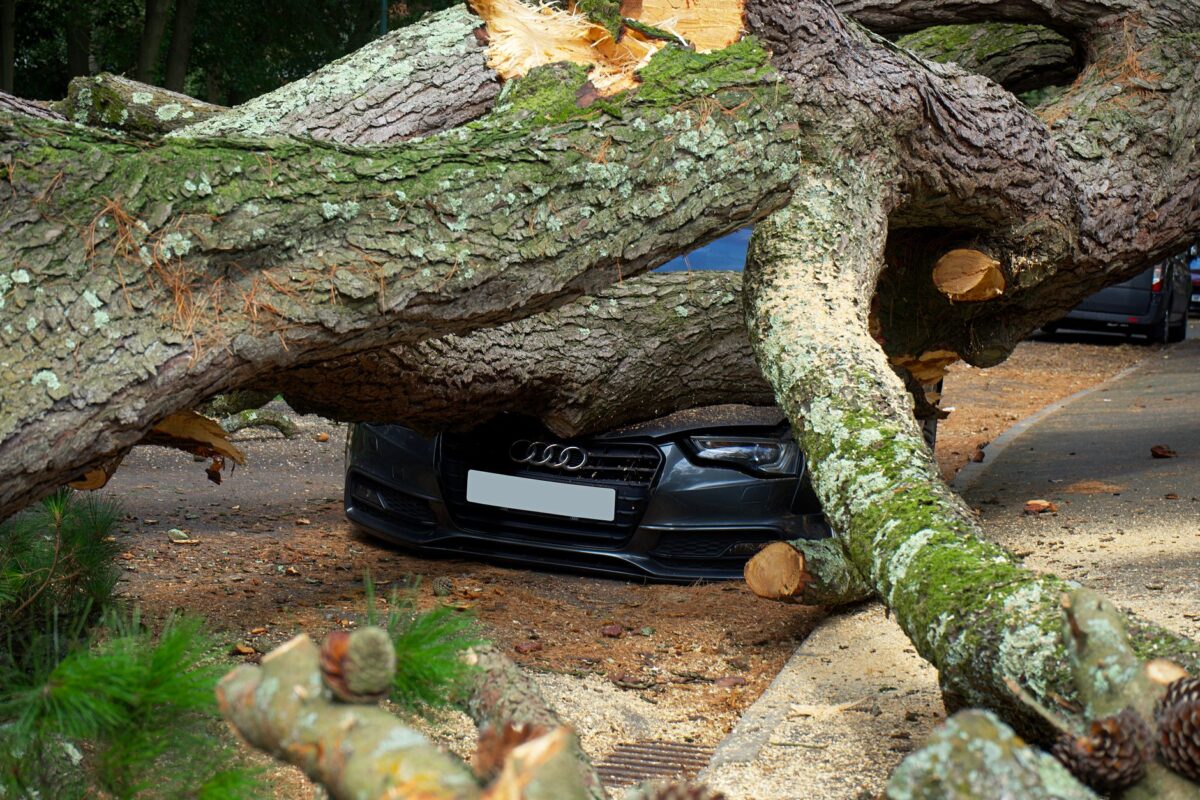
Tree fell car claims surge every time a major storm rolls through, and drivers are often surprised by what happens next. In most cases, the damage is covered — but only if you carry the right type of insurance. Comprehensive coverage, an optional add-on that roughly 80% of insured drivers buy, is what pays for falling objects.
Liability-only policies pay nothing. As a result, a tree fell car situation can mean a fully paid repair for one driver and a total loss for another. This guide explains exactly how a tree fell car claim works, what it costs, and the steps to take in the first 24 hours.
What Coverage Pays When a Tree Falls on Your Car
Comprehensive coverage is the part of your auto policy that handles falling trees and branches. It covers damage from events outside your control that are not collisions. For example, it also pays for hail, fire, theft, vandalism, and animal strikes. According to the Insurance Information Institute, falling objects are a standard comprehensive peril. Collision coverage does not apply here. Liability coverage does not apply either, because liability only pays for damage you cause to others.
However, there is an important catch. Comprehensive coverage only pays for sudden and accidental damage. Typically, a healthy tree knocked over by wind qualifies without question. A rotting tree on your own property that you ignored for years may not. Insurers can deny claims when the damage was preventable through basic maintenance. As a result, dead or leaning trees on your property should be removed before storm season, not after.
Cost is another reason drivers skip this protection. Comprehensive coverage costs about $421 per year on average, or roughly $35 per month, according to Progressive. That is far cheaper than collision coverage, which averages around $743 annually. In a tree fell car scenario, that $35 monthly premium can save you thousands. Drivers with older, low-value vehicles sometimes drop comprehensive to save money. That trade-off makes sense only if you could afford to replace the car yourself.
Tree Fell Car Claims: What They Cost and How Deductibles Work
Every comprehensive claim starts with your deductible. This is the amount you pay before insurance covers the rest. Comprehensive deductibles typically range from $100 to $2,000, with $250, $500, and $1,000 being the most common choices. For example, if a fallen oak causes $4,000 in roof and windshield damage and your deductible is $500, your insurer pays $3,500. You cover the first $500 out of pocket.
Severity varies widely with these claims. A single branch might crack a windshield, a repair that often runs $300 to $500. A full trunk strike can crush the roof, break pillars, and bend the frame. Repairs like that frequently exceed $8,000 to $10,000. In most cases, insurers total a vehicle when repair costs approach 70% to 80% of its actual cash value. If your car is totaled, you receive its market value minus your deductible — not the amount you originally paid.
| Scenario | Who Typically Pays |
|---|---|
| Healthy tree falls in a storm | Your comprehensive coverage, minus deductible |
| Neighbor’s healthy tree falls on your car | Your comprehensive coverage, minus deductible |
| Neighbor’s known-dead tree falls (proven negligence) | Neighbor’s homeowners liability coverage |
| Your neglected, rotting tree falls on your car | Claim may be denied as preventable damage |
| You have liability-only insurance | You pay everything out of pocket |
One more cost worry deserves attention: your rates. A single comprehensive claim typically raises premiums by about 3% to 10%, or roughly $30 to $140 per year. That increase is much smaller than an at-fault accident surcharge. However, if the damage is barely above your deductible, paying out of pocket may still be the smarter move. Run the math before filing a small tree fell car claim.
Who Pays When a Neighbor’s Tree Falls on Your Car
Many drivers assume the tree’s owner automatically pays. In reality, the opposite is usually true. If a neighbor’s healthy tree falls during a storm, the law treats it as an act of nature. Your own comprehensive coverage pays for your car, and you owe your own deductible. The neighbor’s homeowners insurance is not responsible, according to Experian. This surprises people, but it is the standard rule in nearly every state.
Negligence changes everything. If the neighbor knew the tree was dead, diseased, or dangerous and did nothing, they can be held liable. For example, a written warning from you, a citation from the city, or an arborist’s removal recommendation all serve as strong evidence. When negligence is proven, the neighbor’s homeowners liability coverage may pay for your repairs. It may even reimburse your deductible. Document everything with dated photos and keep copies of any letters you send.
Tree removal is a separate question. Typically, your auto insurer pays to lift the tree off your vehicle as part of the claim. However, hauling the debris away from your driveway is usually not covered by your auto policy. Professional removal of a large fallen tree can cost $400 to $2,000 depending on size and access. Homeowners policies sometimes contribute a small amount, often $500 to $1,000, if the tree also damaged insured structures.
What to Do Right After a Tree Falls on Your Car
Safety comes first. Stay away from the vehicle if power lines are tangled in the branches, and call 911 immediately in that situation. Downed lines can energize a car and the ground around it. Once the scene is safe, photograph everything before anyone moves the tree. Capture the full tree, the point of impact, all visible damage, and the surrounding area. Wide shots and close-ups both matter, because adjusters rely heavily on this evidence.
Next, file your claim quickly. Most insurers accept claims by app or phone within minutes. Report the date, time, weather conditions, and location. If the tree came from a neighbor’s yard, note that too. Do not authorize expensive repairs before the adjuster reviews the damage. However, you should take reasonable steps to prevent further harm, such as covering a shattered window with a tarp. Insurers expect this and can reduce payouts if you let damage worsen.
📋 Get Free Insurance Guides
Free · No spam · Unsubscribe anytime
Finally, watch the timeline and push for progress. Adjusters typically inspect within a few days, and straightforward claims often settle within one to two weeks. Complex tree fell car claims involving total losses can take 30 days or more. Ask about rental car coverage, because comprehensive claims include rental reimbursement only if you bought that add-on. If your car is totaled and you owe more than its value, gap insurance covers the difference. A tree fell car total loss without gap coverage can leave you paying a loan on a car that no longer exists.
Frequently Asked Questions
Does full coverage insurance cover a tree falling on my car?
Yes, in most cases. “Full coverage” typically includes comprehensive insurance, which pays for falling objects like trees. You will owe your deductible, however, before the insurer pays the rest.
Will a tree fell car claim raise my insurance rates?
Usually only slightly. Comprehensive claims typically add 3% to 10% to premiums, far less than an at-fault accident. However, multiple claims in three years can trigger larger increases or nonrenewal.
What if I only have liability insurance when a tree fell on my car?
Unfortunately, you would pay for all repairs yourself. Liability coverage only pays for damage you cause to other people. As a result, drivers in storm-prone areas should strongly consider adding comprehensive coverage, which averages about $35 per month.
Compare Insurance Rates
Ready to see if you could be paying less? Compare quotes from top insurers in your area. Getting multiple quotes is the most effective way to find a better rate.
(paid link)
Official Sources & Resources
For verified information on auto insurance regulations and consumer protection:
- NAIC (National Association of Insurance Commissioners): naic.org
- Insurance Information Institute: iii.org
- Federal Trade Commission — Auto Insurance: consumer.ftc.gov
- USA.gov — Car Insurance: usa.gov/car-insurance
Content last reviewed July 2026. If you notice any outdated information, please contact us.