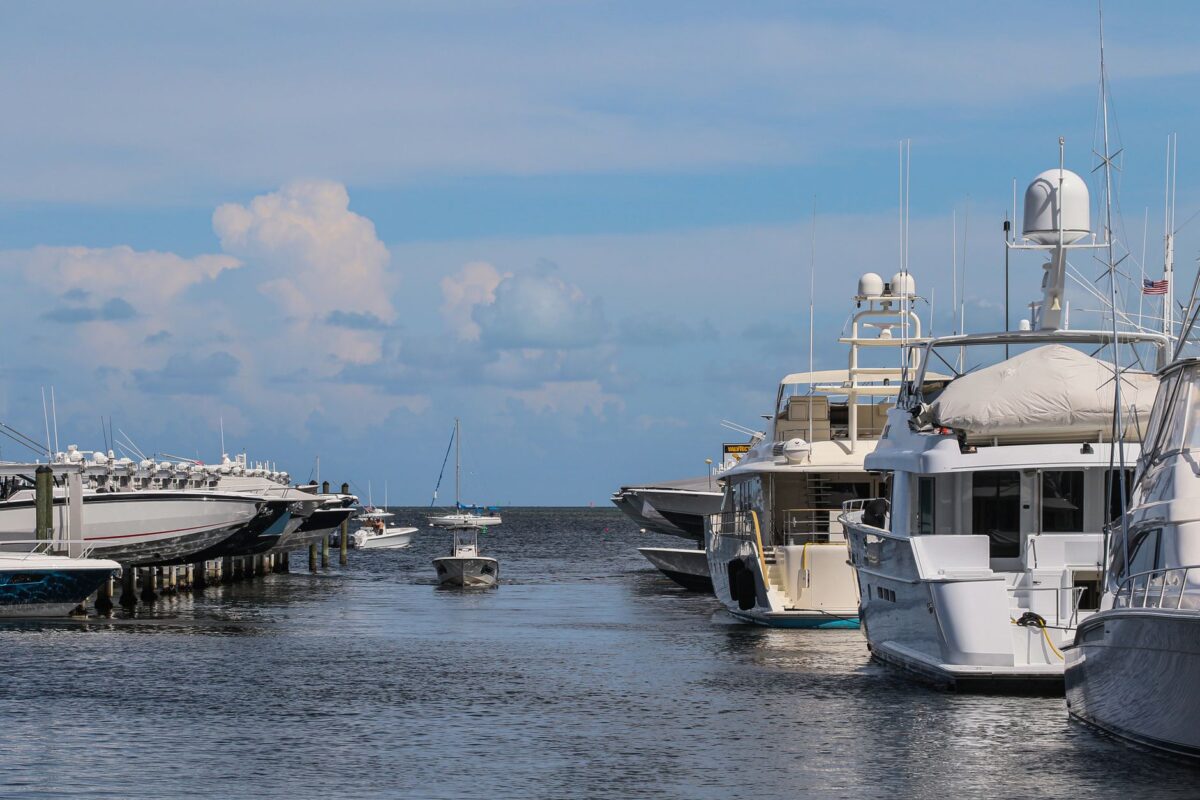
Yacht insurance is a specialized marine policy built for large vessels — generally boats 27 feet and up, and almost always the standard for anything over 40 feet. It is not a bigger version of a small-craft boat policy. These contracts are written on admiralty law principles, with agreed hull value, protection and indemnity liability, salvage and wreck removal, and hard geographic navigation limits. If you own a 45-foot sportfish, a 60-foot motor yacht, or a bluewater cruising sailboat, standard watercraft coverage will not fit. Marinas, lenders, and charter programs also demand proof of it before you get a slip or a loan. In most cases, the policy is the single largest annual ownership cost after dockage and fuel.
What Yacht Insurance Actually Covers
The hull section is the core. Most large-vessel policies are written on an agreed value basis, meaning the carrier pays the stated figure on a total loss, minus the deductible, with no depreciation argument. A $650,000 agreed value pays $650,000. Actual cash value policies pay the depreciated market number instead, which is why agreed value is the standard recommendation on any vessel worth six figures. Partial losses on hull, machinery, and electronics are typically settled at replacement cost on newer boats, with depreciation schedules applied to sails, canvas, and outboards after a set age.
Liability comes through protection and indemnity, not the auto-style “bodily injury” wording. P&I on a large vessel typically runs $500,000 to $5 million, and it covers wreck removal, which can exceed the boat’s own value. For example, removing a sunken 55-footer from a navigable channel can cost $150,000 or more, and the Coast Guard can order it. Pollution liability is separate and important. Federal Water Pollution Control Act limits are often carried at $939,800 per occurrence as a standalone sublimit. Ask for it outside the P&I limit, not inside it.
Crew exposure is the piece owners miss. If you employ a paid captain, mate, or stewardess, they are seamen under the Jones Act, not household employees. Longshore coverage and Jones Act crew endorsements have to be added on purpose. Uninsured boater coverage, personal effects (often $10,000 to $50,000), emergency towing and assistance, tender and dinghy coverage, and fuel spill cleanup round out a typical large-vessel form. Chubb’s Masterpiece Yacht program, for instance, targets vessels 36 feet and longer, with its Preference tier aimed at boats 70 feet and up including captain and crew liability.
What It Costs in 2026
Price is driven by hull value, not by driving record. The working rule in 2026 is roughly 1% to 2% of insured hull value per year in low-risk waters. A $400,000 vessel kept in the Chesapeake or the Great Lakes commonly lands between $4,000 and $8,000 annually. Yachts 50 feet and longer frequently exceed $5,000 even before storm exposure is priced in. Vessels moored in Florida, the Gulf, or the Caribbean routinely rate at 3% to 5% of hull value instead. That is a genuine multiple, not a small surcharge.
Geography is the biggest single lever. Hurricane-zone moorage pushes premiums 30% to 60% above comparable northern coastal rates, and a 30-foot boat in Florida already runs 15% to 20% over low-risk areas. However, rates have largely stabilized after several hard-market years, with 2026 renewals averaging increases near 5% rather than the double-digit jumps of prior seasons. Because rate filings, surplus-lines rules, and storm loads vary widely by state, treat any national average as a starting point only and check your state guide before budgeting.
Other drivers move the number meaningfully. Vessel age matters — many carriers surcharge or decline hulls over 25 to 30 years without a clean recent survey. Operator experience, licensing, and prior claims all price in. Deductibles are typically 1% to 2% of hull value for ordinary damage. Named storm deductibles are separate and much larger, commonly 2% to 10% of insured value. On a $500,000 yacht, a 5% named storm deductible is $25,000 out of pocket before the carrier pays a dollar.
Who Needs Yacht Insurance
The clearest candidates are owners of vessels above roughly 27 to 30 feet with meaningful value, an inboard or twin-diesel drivetrain, and offshore or coastal cruising plans. If you keep a 42-foot cruiser in a marina slip, you almost certainly need this form. Lenders financing a large vessel require agreed value hull coverage naming them as loss payee for the life of the note. Marinas increasingly require $500,000 to $1 million in liability before issuing a slip contract, and many now demand certificate proof annually.
Charter owners and anyone with paid crew need it without question. A homeowners policy will not touch Jones Act crew exposure, and a small-boat watercraft policy typically caps out around 26 feet or a set horsepower. Bluewater cruisers heading to the Bahamas, Mexico, or the Med need navigational limits written to match the itinerary. Extending limits mid-season is possible but usually costs an additional premium and sometimes requires a fresh survey.
Some owners can skip it. A 22-foot center console, a runabout, or a personal watercraft belongs on a standard boat policy, which is far cheaper. Small tenders under a set length and value are often covered automatically under the mothership’s policy. Boats stored in a landlocked barn year-round with no in-water use may be handled under a homeowners endorsement, though that route caps liability sharply and rarely includes salvage.
Common Exclusions and Mistakes
Wear and tear is excluded everywhere. So are gradual deterioration, osmosis and blistering, delamination, marring, scratching, denting, manufacturer’s defects, mold, marine life, vermin, and ordinary corrosion. Stray-current electrolytic corrosion is often the one corrosion type covered. This trips up owners of older fiberglass hulls who assume a sinking traced to a failed through-hull will be paid. If the surveyor’s report ties the loss to deferred maintenance, the claim can fail entirely.
Navigational limits are the second big gap. Coverage applies only inside the geographic box on your declarations page. Cross it without prior written approval and you may have no coverage at all. Most carriers apply a hurricane box requiring the vessel be north of roughly 30.5°N or south of about 10°N from around July 1 to November 1. Lay-up warranties work the same way — if the boat is used during the warranted out-of-commission period, coverage for that period can be void.
📋 Get Free Insurance Guides
Free · No spam · Unsubscribe anytime
The named storm plan is where claims are lost most often. Carriers require a filed hurricane plan and expect execution within a 48 to 72 hour window after a warning is issued. Failing to haul out as promised can reduce or void the storm claim. Special deductibles typically apply from 72 hours before to 72 hours after a named storm passes. Also watch for captain warranties: if the policy names a specific licensed captain, an unlisted operator at the helm can jeopardize the loss.
How to Get the Best Rate
Use a marine specialist agency, not a general property agent. Firms like Global Marine Insurance, Shapiro Insurance Group, and Brown & Brown place across multiple markets, which matters because carriers enter and exit this space regularly. Compare quotes from Chubb, Markel, AIG, and BoatUS/GEICO Marine at minimum. BoatUS offers three tiers — liability only, agreed hull value, and actual cash value — so make sure competing quotes are on the same basis before comparing price.
Get the survey done early and fix the findings. A clean out-of-water survey within the last two to five years is the single strongest underwriting document you have. Correct every recommendation in writing and send the invoices. Typically that alone resolves borderline acceptances on hulls over 20 years old. A licensed captain with documented sea time and appropriate tonnage endorsements also earns materially lower pricing, and a captain-operated warranty can cut premium noticeably.
Chase structural savings, not just discounts. Northern lay-up credits for boats stored outside the hurricane box from June through November are among the largest available. Raising your standard deductible from 1% to 2% of hull value trims premium without touching the storm deductible. Bundling with a high-value homeowners or umbrella carrier often unlocks account credits. As a result, most owners find 15% to 25% in savings by restructuring rather than shopping alone. Finally, renew 60 days early — last-minute submissions in May and June, right before hurricane season, get the worst terms.
Frequently Asked Questions
Do I need a marine survey to buy yacht insurance?
Usually yes on any used vessel, and nearly always on hulls over 20 to 25 years old. Carriers want a recent out-of-water condition and value survey, typically within two to five years. Expect $20 to $30 per foot. Underwriters also expect written proof that survey recommendations were corrected, with invoices attached to the submission.
What happens if I cruise outside my navigational limits?
Coverage can be suspended entirely while you are outside the box. There is no partial credit. Call your agent before you go — most carriers will extend limits to the Bahamas, Caribbean, or Mexico for an additional premium. For example, a Bahamas extension is often a few hundred dollars and takes a day. Get the endorsement in writing before departure.
Is a named storm deductible the same as my regular deductible?
No, and the difference is expensive. Standard hull deductibles usually run 1% to 2% of agreed value. Named storm deductibles run 2% to 10%, or flat amounts of $10,000 to $25,000. On a $500,000 yacht, a 5% storm deductible means $25,000 out of pocket. The storm deductible typically applies from 72 hours before landfall.
Does my policy cover a paid captain who gets hurt aboard?
Only if crew coverage is specifically added. Paid captains and crew are seamen under the Jones Act, so you owe maintenance, cure, and potential negligence damages. Homeowners and standard watercraft policies exclude this entirely. Add Jones Act and Longshore endorsements before hiring anyone, including a delivery captain for a single trip.
Compare Boat Insurance Rates
Rates for boat insurance vary widely between carriers, and the specialists often beat the big
national names. Comparing several quotes is the single most reliable way to pay less.
(paid link)
Official Sources & Resources
For verified information relevant to boat owners:
- U.S. Coast Guard Boating Safety Division: uscgboating.org
- NAIC (National Association of Insurance Commissioners): naic.org
- Insurance Information Institute: iii.org
- AM Best – Insurer Financial Strength: ambest.com
Content last reviewed July 2026. If you notice any outdated information, please contact us.